Women of the south: Sisters are doing it for themselves
Women of the south: Sisters are doing it for themselves
Monday, March 7, 2011
CHRIS DRUM BERKAYA
The approach of International Women’s Day brings with it an opportunity to celebrate women’s rights and a chance to raise awareness of women’s problems in southern Turkey
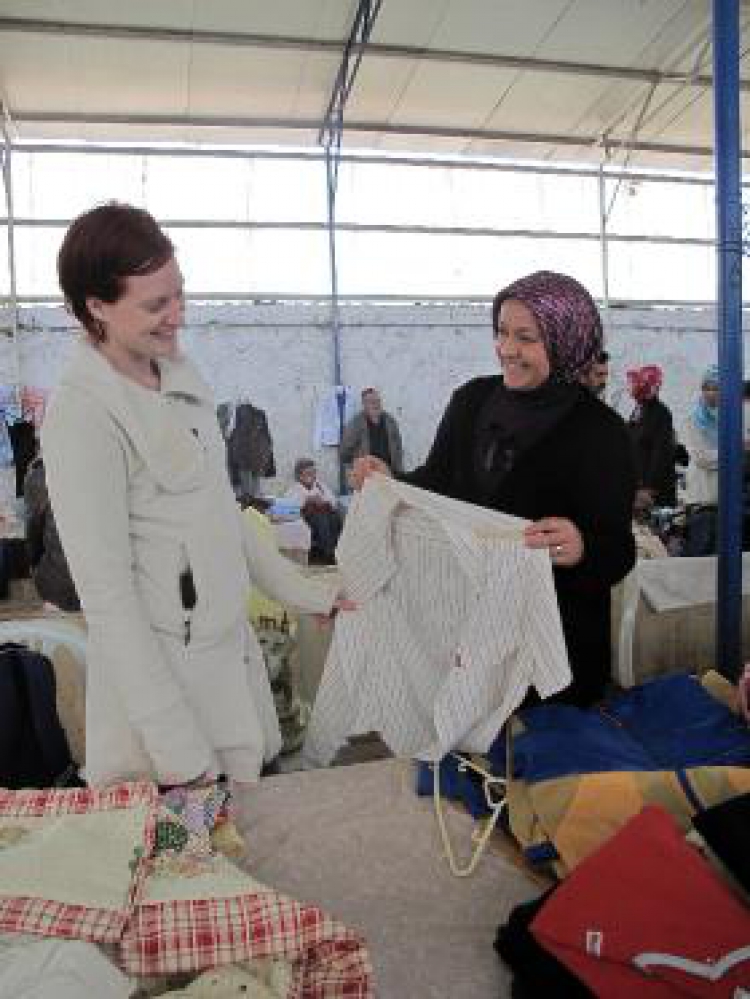
Women are evident in every walk of life in southwest Turkey: working in banks, offices, agriculture, markets, and of course in industry, commerce and tourism. The southwestern province of Muğla boasts the highest average level of education for women in the country and bears the honor of the appointment of Layla Ataman back in the 1990s as the only woman provincial governor – the highest-ranking civil servant in a province – that Turkey has ever had. Women’s participation in this region seems to be higher in education, employment and social service than the country’s low overall rate.
In preparation for International Women’s Day, or IWD, on March 8, South Weekly asked a selection of Turkish women about their views and concerns about women in southwest Turkey.
Many women in the region will not be marking the day, unaware either of it or its aims. Yet they, like others around the world, are the beneficiaries of the campaigns that were started for women’s rights and equality.
No change in the village
Dilek Karakuş did not know about IWD and that was not unusual in the rural areas of Turkey where very little makes an impact on the day-to-day lives of women. Karakuş, a mother of two in her mid-40s, lives with her family in a traditional, agricultural village on the Aegean coast. She does not have a regular job; she finds seasonal work in the local gardens and olive groves, and frequently goes fishing with her husband on their “sandal,” a small traditional Turkish fishing boat.
Her husband works in a fulltime job; her eldest daughter is at university while her second daughter is studying for her university entrance exam.
“The Turkish government is attempting to join the European Union, but I haven’t felt any changes to the local community that can be attributed to the accession process. Perhaps in the cities the women can see some benefits, but I haven’t experienced any changes myself,” Karakuş said.
And she is not alone. Her friend, who wished to remain anonymous, agreed that there had been little change. “I’m not sure what changes the EU could bring, maybe the job opportunities for women would increase?”
“They [the ruling Justice and Development Party, or AKP] could do more for women, and definitely more for female children,” Karakuş said. “We need compulsory education for all young girls; it’s no good having such a law if you don’t enforce it in all areas of Turkey. We need equality and more support for women who are victimized in their homes or in their communities. Honor killings need to be eradicated.”
Karakuş said she was aware of the problems some women face. “I know that a woman’s rights and freedoms vary in different parts of Turkey, and this needs to be addressed. Everyone should have their freedom.”
An easy path
In Bodrum, Aslıhan Mutlu admitted that her path to being independent and becoming a businesswoman was easy.
“I came from a well-educated family, even my grandmother was a university graduate, a rare thing for her generation,” she said. “I have worked since I was 18, always in Turkey, but traveled extensively in different parts of the world, worked for the private and government sectors, then opened my own travel company and worked very hard. I would say I have never faced any obstacles as a woman.”
Asked to compare her experiences in Istanbul and in the last four years in Bodrum, she said: “I have not found any difference as a woman in business here in Bodrum – not that there aren’t difficulties, but they are the same for everyone in business. You have to be strong, really strong; otherwise Turkish men will take advantage of any weakness. Be strong and you get respect.”
She discussed the familiar childcare dilemma for women, which is particularly acute in Turkey. “Up until they marry, an educated woman [in Turkey] is a first-class citizen, then they take on the family responsibilities. Thank goodness for mothers, grandmothers and even mothers-in-law [who baby-sit]. Without them, there is no way a woman could continue to work. Women [in Turkey] are working and living essentially as single parents. Men – their husbands – rarely help, and of course the workplaces will not allow men to take time off for ill children or school business, as women have to.”
She said she had to learn her rights as she went along. “Until recently it was in the law that a husband had to grant permission for his wife to work, I did not know that when I married young. And then when I started divorce proceedings, my husband wrote to my employer to ‘cancel his permission.’ Thankfully, my employer stood up to him. But because of that, I later refused to marry my partner, now second husband, until that law was repealed. Why should I give someone that power over me?”
Self-made women
Lawyer Şule Beder, born in Fethiye, is a highly successful 32-year-old. “As a businesswoman I have benefited from my life chances, but I made the right choices for me,” Beder said. “My father, a retired imam, has been asked why we weren’t sent to a religious school. He said we could choose our career or whether or not to cover our heads. My mother is a village woman and one of the cleverest women I know with wonderful common sense. But I left home at 13 and am independent.”
She outlined her education and career path: “I took my secondary schooling in Istanbul, passing my exams at 13. I had choices but nursing seemed the most suitable because my parents couldn’t afford the science high school option. [Nursing school is paid for by the state.] It all depends on the points you get at 13 years old. The nursing high school lasted four years, then at 17 I went to work in Niğde province [in Central Anatolia] but applied to university, Gazi University in Ankara, to study law. At 18 I was the top student in my year at Gazi. After Ankara, I then went to the United Kingdom to study British law,” she said.
“I also taught myself English. I was working for the Turkish Navy as a legal adviser and went to London for them. Realizing my English wasn’t good enough; I decided I would learn it. After eight months I took my first international English exam. I got the highest mark possible,” said Beder.
“Coming back to Fethiye was like a dream come true, I love living here. This is my home. I now represent some U.K. law firms here. All the hard work I had done, studying law, learning English, going to England was just what I needed to open my own law office here. Eighty-five percent of my clients are foreign,” she said.
“When I came back I wasn’t expecting much, but Fethiye is now so different because of the increase in foreigners over the last 10 years. Their involvement has made the town more open and changed the mentality. Fethiye has the chance to be more like İzmir, perhaps,” Beder said.
“People are valuable to me and ‘womanship’ means they should be more respectful of themselves. Women should be free but they should respect themselves. Turkish women here are becoming more independent. Before they would do what they were told, but now they are following their own way,” she said.
From the village
Çiğdem Sarı Fraser, owner of a travel agency in Bodrum, is another woman who came from a village. “I was born in Konacık village [now a municipality adjacent to Bodrum town] when there was no electricity there. When I was 6, we moved to Bodrum where my parents ran a pension for tourists and I came in contact with many educated people: professors, doctors and the like. That opened my mind and I wanted to study. In fact I am still learning and discovering – I will never stop. When I was at school I studied non-stop, I would cry if I got anything less than a great score on a test. That was while the other girls were enjoying themselves, partying and not studying. I worked hard and got into a university in İzmir to study French. I am the only girl from my high school class to work in a career since,” Fraser said.
“My mother had wanted to go to nursing school and my father had also wanted to study more, so they understood and supported me. I worked in the marina, for Milta Tourism, then for Europcar car hire when we worked with the British tour operators in the late 1980s and early 1990s. Then I worked with Sun Rent-a-Car. Using my experience I set up my own car hire company in February
“Yes, I believe I was one of the few young Bodrum women then, like Gül Beyaz, who were working in an office and tourism in the late 1980s. I could have gone elsewhere but I liked Bodrum. I don’t think the foreign element made a great difference to Bodrum. I actually don’t know if I was one of the first women to open a company in Bodrum, but there were no obstacles as a woman,” she said.
She said the obstacle was now the seasonal nature of Bodrum’s revenue.
Common problems of small traders
Gül Beyaz agreed with the same view on incomes in Bodrum, as she is dependent on locals having spending power to shop at the small lingerie shop in central Bodrum that she started two years ago.
She had worked for 20 years in the tourism ferryboat offices from the age 18 and was one of the first young women working in tourism offices in Bodrum. She has found the shop business so difficult that she is planning to sell it. Her reasons are partly due to low sales, partly personal, but also due to the overheads entailed by bureaucracy for taxes and fees.
“Why should I pay tax on rent I am paying out?” she asked, adding that she was also stymied from joining the ESNAF Small Traders Chamber because they required her to obtain an “usta belgesi” trade certificate, which is obligatory for hairdressers, cooks and others; why it was applied to simple shopkeeping was lost on her.
“So I had to join the Chamber of Commerce – where you pay more for the compulsory monthly fee, and the compulsory monthly accountant’s fees, et cetera,” she said.
But these are common problems shared by any small trader and she said she never had any problems as a woman because her family had supported her and because she was able to obtain the financial support necessary to start up the business. “You can’t get it from the banks,” she said.
Fraser has had a policy of encouraging younger women to work. She said she took on only girls for work internships, but now no longer does after some bad experiences. “I took the students, and the teachers were very happy with me because I actually taught the girls all aspects of the work like making reservations and booking tickets. I didn’t get them to just make coffee. I have had some smart girls who went to university and I took on my present girl after she finished studying. But once I had a high school girl who wanted to read a magazine 10 minutes after her first training session. I let her go at the end of her first day!”
Sarı Fraser is an active member of the local branch of Association of Turkish Travel Agencies, or TÜRSAB, committee and the (mainly female) Tourism committee within the Bodrum Chamber of Commerce, though she said the overall male hierarchy of the chamber needed to do more for women.
She said she approved of a new program for training women in computers and making websites that was recently set up at the Bodrum Adult Education Center by the Bodrum Municipality Public Relations Department that was designed to help get women into work.
Ultimately, however, “girls have to make the best of their opportunities,” she said.
Women working for change
Nesrin Saatçı is a retired science teacher who, with her husband, Fethiye’s mayor, started the “Fethiye Evi,” or Fethiye House, six years ago. It was a dilapidated old Rumevi (Greek house) in the middle of town, and is now an important meeting place for local women. There, women make food to sell to both men and women.
“Our women need to earn money and this place gives them a chance to do that. Divorced or widowed women can make some money for themselves here. It is not possible for all women to have the same chances, but Turkish women have their own culture that can make them rich in different ways. I believe Turkish woman are powerful in their own way, often working behind the scenes, encouraging their husbands, sometimes without their husbands even realizing it,” Saatçı said.
“For me, Fethiye women have a balance. There is more than just tourism here; there is agriculture and business too. The women here have some power to choose. They have the opportunity to be independent. The village women are strong too. We have our own skills; some try to develop carpet-weaving skills. Unfortunately these important skills are undervalued in the marketplace,” she said, adding that she believed undervaluing women’s important skills was a global problem.
Potential for change
Mutlu in Bodrum feels there is potential for change. “Now, I have joined the women entrepreneur’s group set up at the Bodrum Chamber of Commerce. I want to be involved in assisting women to start working, developing skills and getting into the workforce. There are programs, many to help women earn income from handcrafts done at home, et cetera, but it is about getting many people to be aware of them and to believe that the funds are there and to apply for them. For example İŞKUR, the employment agency, has important funds to get women into work where companies can get paid to train staff,” she said.
“I really hope we can successfully implement projects through the women’s group in the Bodrum Chamber of Commerce,” Mutlu said.
Sibel Topanoğlu is one of the prime movers in the women entrepreneur’s group at the Bodrum Chamber of Commerce. She is the owner of a large foodstuffs distribution company in Bodrum that she worked at establishing with her husband before he died eight years ago.
She said at the time of his death, she thought about selling the company but realized she needed to support herself and her son who now wants to go to university. She herself is a university graduate and had to move through many schools throughout Turkey when her father was an electrical engineer. In fact her father was from Bodrum where she met her husband. At its largest four years ago, her company employed up to 140 people in summer, but when she dropped two of the largest multinational drinks brands, she wound back to 45 employees. She said it was still a very demanding job but added that she was enthused by getting two projects and a program for supporting and getting women into business through the chamber of commerce. Some of it entails getting chamber statutes changed that will ease the bureaucratic burdens that many find difficult and some of it is about training women to enter business.
Topanoğlu is enthusiastic about the work that women’s entrepreneurial committees are doing through local chambers of commerce in Fethiye, Marmaris, Muğla, Milas and Bodrum.
She said they had been supported by research carried out by Muğla University into just what is needed.
Topanoğlu said there was support from the Ankara Chamber of Commerce and several government bodies and some banks to help women earn their own income.
“We are opening a way for them,” she said. “I am not getting into social questions, but generally Bodrum women are strong enough and they can get more education to do these things.”
In her village, Karakuş also said she believed financial government assistance would benefit women and would allow them more freedom. “For those women without financial freedom who cannot or are denied the right to work, the prospect of not having to ask or wait for their husbands to give them an allowance would improve their standard of living greatly.”
Karakuş is certainly one of the lucky ones; she does not feel her husband interferes in her private affairs, but not everyone is so lucky.
Her friend explained, “It’s simple. If I have money, I have freedom. If I don’t have money, I don’t have freedom!” As depressing as that may sound, both women laughed.
* Jane Akatay from Fethiye and