The Yassıada Shipwrecks Exhibition – Underwater Archaeology Museum of Bodrum – Bodrum Castle

Yassıada is located approximately 3.5 nautical miles from Turgutreis, on the western tip of the Bodrum Peninsula.
The Yassıada shelf is a rocky heel extending approximately 200 m southwest of Yassıada and has a depth of only 1.5 m.
When the wind blows from the northwest (known as the Meltem), as it tends to do during the summer months (the primary cruising season) in this area, it can be hard work for the boats to navigate. Just as they think they have made it to a safe anchorage, these shallows can lull them into a false sense of security. Instead of the imagined haven, the boats’ hulls can be damaged by the shallow, sharp rocks lying just underneath. (See: Representative drawing)

Graphic Presentation of Yassıada Shelf
From the 1st century BC to the 20th century AD, this place has become the permanent resting place of many ships from different periods (the most recent was the Lebanese ship Mirna-M, which sank in 1993). A total of 16 shipwrecks have been identified in this ship cemetery so far.
Of these, there have been excavations of three ships belonging to the 5th and 7th centuries, the late Roman/Byzantine Period, and the 16th-century Ottoman period.
The finds from these three excavations are exhibited in the Yassıada Shipwreck Hall, and information about all of them is displayed on the wall panels.
The Yassıada excavations are among the oldest underwater archaeological excavations. They were conducted under the leadership of George Bass, Frederick van Doorninck, and Cemal Pulak within the Institute of Nautical Archaeology (INA), which played a pioneering role in the methodology of underwater archaeology and contributed to the training of many scientists and experts in this field.
In 2017, the Bodrum Museum of Underwater Archaeology began the Yassıada shipwreck research-documentation project, with the technical support of the Institute of Nautical Archaeology (INA). This project aims to minimize data loss by documenting shipwrecks using modern techniques.
Ottoman Shipwreck

Model of the Ottoman Shipwreck- Castle of Bodrum
The finds from the Ottoman Shipwreck are displayed among the exhibits in the Yassıada Shipwrecks Hall It is the first Ottoman shipwreck to have been excavated. Like the other two shipwrecks, the ship crashed into the shallow rocks near the island and sank. In addition to the Lebanese-flagged cargo ship that sank in 1993 in the same area, more than a dozen ships sank in antiquity. The available data suggests that the Ottoman ship remained on the shallow rocks before disintegrating and sinking.
When the wood recovered from the ship was evaluated, it was discovered that the boat was long and 6m wide, with its hull made of oak and the lining of beech. The first finds were four reales (Spanish coins from the era of Philip II, 1566-1589). However, only one of them could be dated with certainty to the 16th century. The use of dendrochronological tree-ring counting on its keel shows that the ship was built around 1572.
The Late Roman Shipwreck of the 5th Century
This shipwreck was excavated in 1966-1969 and again in 1974, but was left unfinished due to the events in Cyprus. Its cargo and utility vessels were found to be remarkably well-preserved, and all finds were dated to 400 AD.
Inside, many utensils belonging to the Late Roman Period were found at the stern. These items include plates, a bowl, several jugs, cooking utensils, two large vessels used to store water, and four terracotta oil lamps alongside other ship equipment.
The shape of the lamps and the signature of a well-known Athenian oil lamp maker, etched into the clay on one of them, helped to determine that the ship sank in the late 4th century.
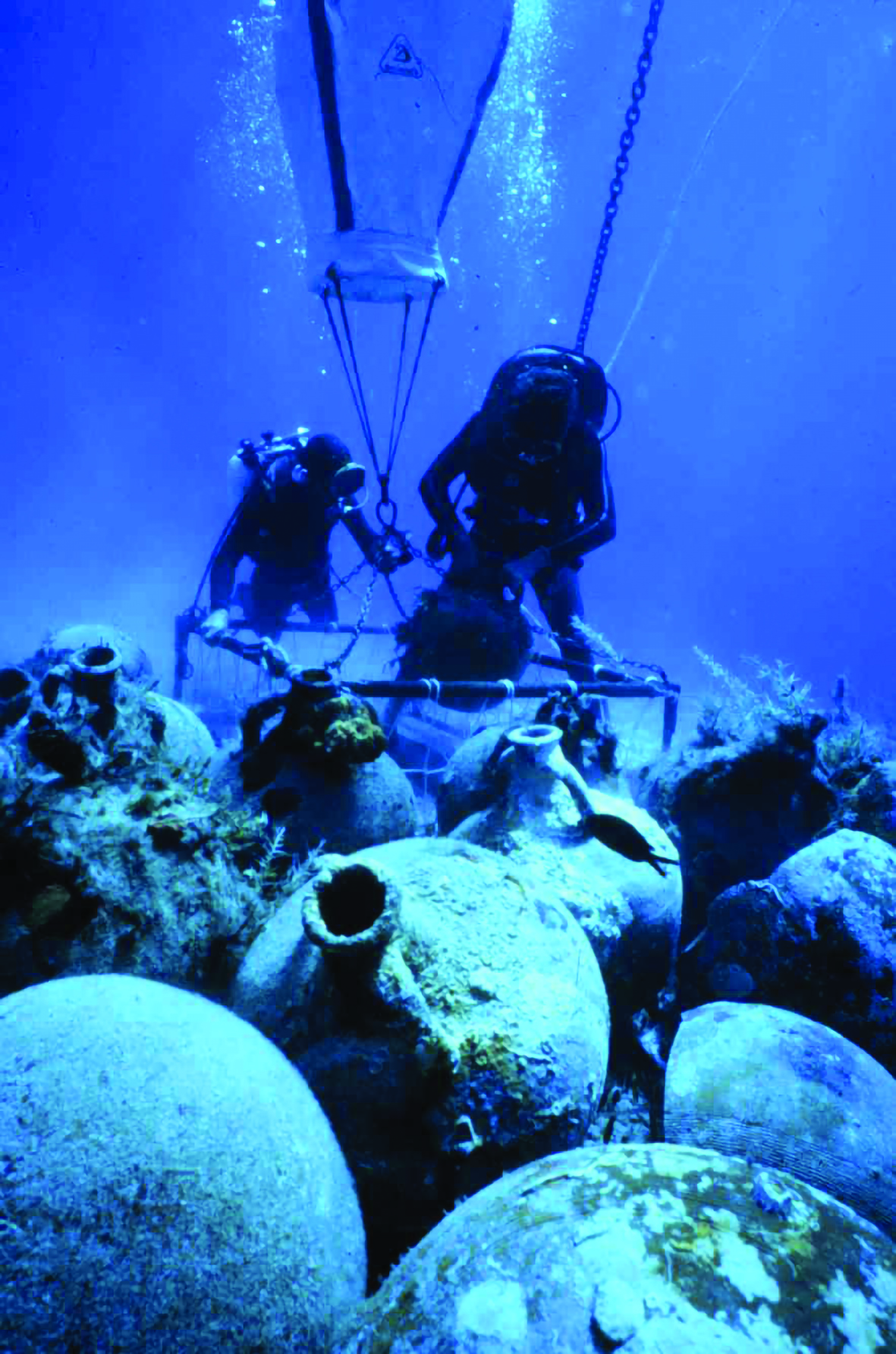
Divers near the Yassıada Shipwreck photo by: Donald Frey (INA)
The 7th Century Byzantine Shipwreck
The Yassıada 7th Century Shipwreck was excavated, with a total of 3,533 dives. One of the unique features of this
shipwreck is the brick hearth and kitchen roof.
The kitchen contained pots, cauldrons, jugs, a copper pan, and fine dining sets for four or five people.
In front of the galley, gold and copper coins, carpenter’s tools, unused oil lamps, scale weights, and scales were found.
The ship was carrying around 900 amphorae, covered with tree resin and mainly containing wine.
Some amphorae containing other ingredients, such as olive oil, incense oil, or lentils, were engraved with what they were carrying.
The Yassıada Shipwrecks Hall is not only a hall that exhibits the finds from these three shipwrecks, but it also provides details of many of the ancient treasures lying hidden underwater, just off the coast of Türkiye, ready to challenge the underwater archaeology teams around the world.
This article is taken from Necip Damar‘s book “Bodrum – All About Bodrum”