Bodrum’s two Artemisias: one of warrior, the other is in love…

Whether it is from its soil or water, Bodrum has many famous people. In this article, I will tell you about Bodrum’s two most famous women: Queen Artemisia I and Queen Artemisia II. Although their names are different, they are often thought to be the same person. Some even believe that the Queen Ada exhibit in the castle at the Underwater Archaeology Museum is also Artemisia.
If you say, “How can you talk about them as the two most famous women in Bodrum when they are so little known in Bodrum?” remember that they have been in the pages of history for about two thousand four hundred years.
For over two thousand four hundred years, they have been known by seafarers, archaeologists, art historians, combatants, strategists, history buffs, researchers, and many more, possibly ink-licked wise people, many of whom are not yet alive. Do you know any other women like this? How many famous women are still on the agenda after all these years?
Moreover, there were no image makers, public relations personnel, or social media channels in those days.

Statue of Artemisia II Mausolos with Vase with Ashes in Schönbrunn Palace-Austria-Vienna
We cannot ignore Herodotus’s contribution to making Queen and Admiral Artemisia I so famous, but Herodotus was also the father of history.
Who knows Herodotus? What would he write in the history book if he had reigned? Unfortunately, Artemisia II was born years after Herodotus.
Herodotus saw neither the Mausoleum nor the time of Mausolus
Artemisia I and II were probably women who were fond of their beauty, liked to be seen and remembered, like every woman, and who knows, maybe they were curious about gossip. The difference between them was that they both had intelligence, courage, and heroism. Their names are written in golden letters not only in Bodrum’s history but also in world history.
They were Warriors of Caria, and both were known for their work. Both were queens and admirals, not only in the sense of the king’s consort but also in the sense of head of state.
Queen Artemisia I, the first known female admiral in history and the heroine of the Sea Battle of Salamis; Queen Artemisia II, on the other hand, was a victorious admiral thanks to the strategy she devised, an art lover who introduced the word Mausoleum to world literature and was the producer of the Mausoleum, one of the seven wonders of the world.
As she was undoubtedly the most renowned hero of the first great naval battle in history, Salamis. Although the Persian navy, with which she fought, was defeated, she managed to sink dozens of enemy ships with her single ship and one ship from the Persian navy, claiming it was not by accident, but on purpose, to save herself, and she survived this deadly battle.
Moreover, even though she insisted to the pre-war Persian ruler Xerxes (Serhat)that he should not enter this war and that they would be defeated, Xerxes did not listen to her. However, the following words were recorded in history when he had to leave his entire fleet in the Aegean Sea after the war: “Today men fought like women, women like men.”
On the other hand, Artemisia II was both the sister and wife of Mausolos, the famous satrap of Bodrum. This sisterly relationship was accepted in some regions at that time. Even before her husband died, Artemisia II began building a mausoleum that would take years to complete, even after both her husband and she had passed away, to keep his memory alive and create a monument that the whole world would admire.
The Mausoleum was built by the best sculptors, marble masters, and architects of the period. Connoisseurs chose it as one of the world’s seven wonders. The name “Mausoleum” seems to have remained alive as long as people have existed.
Today, the word “Mausoleum” is used in many languages to refer to the graves of famous historical figures, such as Atatürk’s or Lenin’s. Therefore, Queen Artemisia II has fully achieved her goal of immortalizing the name of Mausolos.
As for the admiralty of Artemisia, when the second Artemisia, who came to power after her husband Mausolos died, had to defend her hometown against the Rhodesians, who did not want to be under the rule of a woman, she prepared a very clever defense plan against the Rhodesian navy, which attacked Halicarnassus from the sea.
The Rhodesians, who were confused about what to do in the face of the Halicarnassus navy, which allowed them to come as far as Halicarnassus and attack their ships by besieging them from behind, suffered a great defeat.

The Victory of Salamis “Salamis Victory” by the French painter Fernand Cormon (1845-1924); Cormon was the teacher of both Toulouse Lautrec and Vincent Van Gogh. Our well-known painters, such as F Hüseyin Avni Lifij and İbrahim Çallı, took lessons from Fernand Cormon in Paris.Queen Artemisia II, the admiral of the Halicarnassus navy, captured the Rhodesian navy’s ships. Halicarnassus soldiers then set out for Rhodes with the vessels of the Rhodesian navy. Rhodes was quickly taken over, and the Rhodesians rushed to celebrate under the illusion that they had won instead of preparing for war, believing their navy had arrived.
A monument was built in Rhodes from the weapons of the defeated soldiers; according to tradition, it should have been destroyed immediately.
In order not to remove this monument, which embarrassed the Rhodesians, it was surrounded by a wall and declared a forbidden zone. It is also said that the memorial erected there was surrounded by walls by the Rhodesians, who were ashamed to be defeated by a woman.
With her intelligence and warrior spirit, Artemisia II proved that she was following in the footsteps of her ancestor, Artemisia I. As the world’s second female admiral, she carried her fame beyond the borders of Caria.
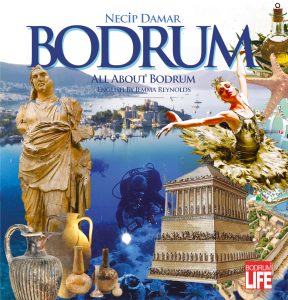
This article is taken from the book “All about the Bodrum” by Necip Damar.
Author: İkbal Çiğdem Köse