Three Faces of Bodrum Castle
This article was written by Tony Marciniec in 1996 and
published in the English Bodrum Post magazine.
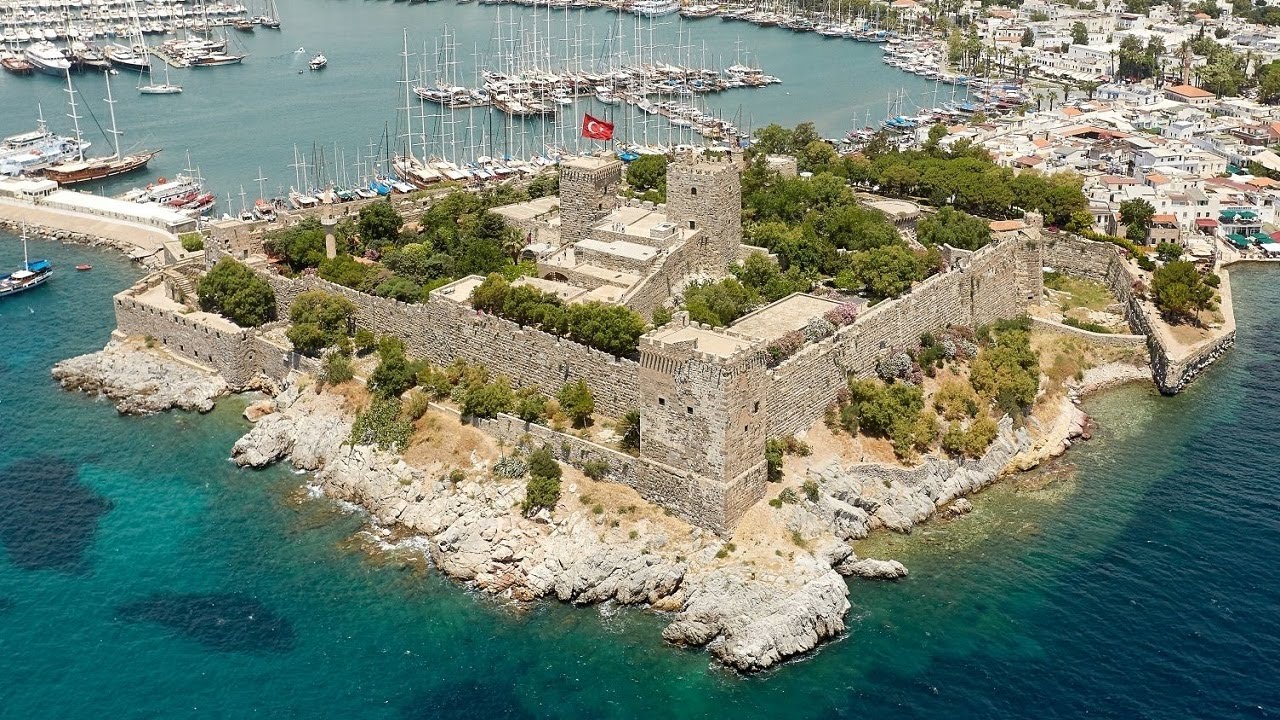
Its massive battlemented walls, five towers and seven gates show that it was once a fortress of note. Numerous inscriptions and coats-of-arms embedded at various points in the structure testify to its medieval, multi-national Crusader origins – there are no visible traces left of previous Carian, Roman, Byzantine and Seljuk construction. Though their proprietorship of the castle lasted only some 120 years, the prevailing aura today is still of its Crusader builders, the Knights Hospitaller of St. John. This is due to a large extent to the castle’s restoration and accentuation with period furnishings done by Turkish authorities after its transformation into a museum.
castle1This period of the Bodrum Castle may be of particular interest to the western visitor due to many associations with historical events which have made lasting impressions on European heritage and culture. Such interest presupposes some knowledge of medieval European history or, at least, some familiarity with Shakespeare. Why Shakespeare? Because, in the play “Henry IV”, the Bard mentions by name a number of the English knights who fought in the battle of Agincourt – the roll-call of honor includes Bedford, Exeter, Warwick, Salisbury, and Gloucester – whose coats-of-arms can be seen today above the portal of the English Tower. These escutcheons are an acknowledgment of their owners’ financial contributions to the construction of the tower, what is known today as ‘sponsorship’.
Very appropriately there are also many reminders of French presence here since a Frenchman, Philibert de Naillac, was the Grand Master of the Order when the castle was founded. When we look at the royal arms of France on the north wall perhaps some will remember that the inscribed date, 1460, was near the end of the reign of Charles VII whose coronation was made possible by Jeanne d’Arc’s victory over the English at Orleans. It is interesting to speculate how French and English knights coexisted in Bodrum when their native lands were at war with each other…
German visitors can admire the handiwork of their countryman Henrik Schlegelholdt, the chief architect of the fortress. The restored German Tower bears the escutcheon of the German Langue or “Tongue”. This designation identified knights within the Order by their linguistic groups, language being the primary indicator of their nationality. By the 1400s there were few German knights in the Hospitaller Order, most preferring to enlist in the Order of Teutonic Knights active in Prussia. Spaniards and Italians can also find traces left by their countrymen in the Bodrum Castle, associations that fill out the tapestry of the fifteenth century in Western Europe.
This medieval aspect of the castle blends well with its second face reflecting its current status as one of the world’s finest museums of underwater archaeology. Amphoras strewn around castle grounds set the atmosphere for visits to exhibits of superb artifacts recovered from ancient shipwrecks, a reconstructed wreck and displays of the underwater excavation process. The harmony between the ancient maritime exhibits and the medieval setting is noteworthy.
castle2The third, mostly forgotten face of the Bodrum Castle is that of a prison, established as such in 1893 in the reign of Abdulhamid II. This sultan, known for his phobia of plots against his absolute rule and his suppression of civil liberties, had many champions of freedom sent into exile or imprisoned, some in the Bodrum Castle. But not only supporters of liberty were jailed here. When reactionary fanatics tried to have Islamic religious law (Seriat) re-imposed after liberal laws were enacted, two of their foremost rabble-rousers were sentenced to life imprisonment in the Bodrum Castle when the rebellion was defeated.
Some captured mountain robbers also spent time behind the castle walls. After the turn of the century bands of outlaws infested the mountains and forests robbing the rich and, sometimes, helping the poor. Some of their leaders, known as “Efe”, have been immortalized in folk songs and their dignified, deliberate demeanor and colorful dress can be readily seen in Aegean folk costumes and dances.